If you’ve ever watched your German Shepherd move confidently through the yard at night, you might have wondered – can German Shepherds see in the dark? Their ability to react to sounds, track movement, or spot things you can barely make out feels almost supernatural.
In this article, we’ll uncover how their eyes work, what gives them this incredible ability, and whether they can truly see in total darkness. Let’s take a closer look into the world through your German Shepherd’s eyes.
Understanding How Dog Vision Works
Before we can answer “can German Shepherds see in the dark,” it helps to understand how dog vision actually works.
Dogs rely on vision that’s tuned more for motion and light sensitivity than for vivid color. Their eyes contain a high number of rod cells, which respond quickly to movement and allow them to notice even subtle changes around them. These rods also make dogs more sensitive to dim light, helping them remain aware and alert when visibility drops.
Why German Shepherds Are So Good at Night Vision
It’s not just a coincidence that German Shepherds seem to move confidently through the dark. Their eyes are equipped with built-in biological tools that make them naturally skilled night navigators.
Tapetum Lucidum – The Built-In Light Reflector
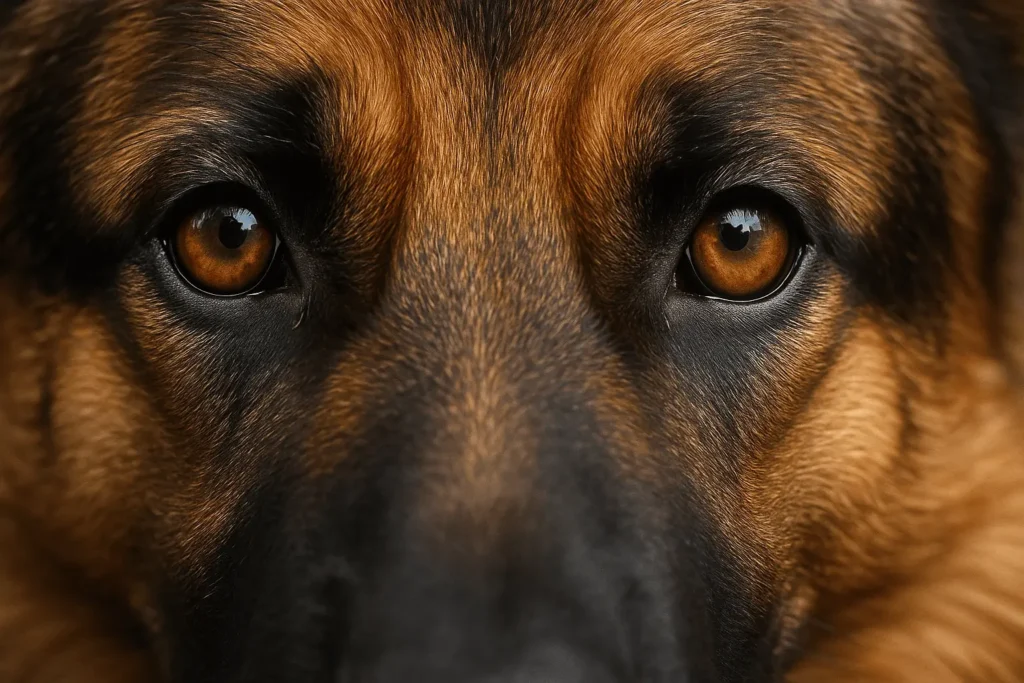
Ever notice your German Shepherd’s eyes glowing in photos or under headlights at night? That shimmer comes from the tapetum lucidum – a thin reflective layer behind the retina.
- It acts like a mirror, bouncing incoming light back through the retina so the eye can make a “second attempt” at capturing it.
- This process amplifies low-light vision, allowing Shepherds to detect shapes and motion even when light is scarce.
- The glow is a sign of this adaptation at work – proof that their eyes are designed for the dark.
Superior Light Processing – Rods, Cones, and Pupil Size
German Shepherds have a particularly high rod-to-cone ratio, meaning their eyes contain a greater number of light-sensitive rod cells than color-sensitive cone cells. This adaptation allows them to capture and process more light in dim environments with ease.
Their large, wide pupils further boost this ability by allowing extra light to enter, maximizing the performance of their rod cells.
Wide-Angle Vision and Motion Sensitivity
German Shepherds also benefit from a wide field of vision – around 250 degrees.
- Their retinas are packed with rod cells specialized for motion, so they instantly notice even the smallest movements.
- In the dark, this means they can detect rustling, shifting shadows, or approaching animals.
Evolutionary Advantage as Herding and Guard Dogs
German Shepherds owe their strong night vision to centuries of evolution that favored survival in low-light conditions. Their ancestors worked alongside humans as herding and guarding dogs, often active at dawn, dusk, and during night hours when predators were most likely to strike.
Over time, dogs that could see, sense, and react better in dim light were more successful at protecting flocks and staying alert to danger – and those traits were passed down through generations. Through this natural selection and purposeful breeding, German Shepherds evolved into dogs that instinctively perform best when visibility drops.
How Far Can German Shepherds See in the Dark?
So, we know that German Shepherds have excellent night vision – but just how far can they actually see in low-light conditions? The answer depends on several factors, including the amount of available light, distance, and motion.
Estimating Their Night Vision Range
While it’s hard to measure an exact “distance,” studies suggest that dogs like German Shepherds can see five times better in dim light than humans. Under typical moonlight, a German Shepherd can detect movement or shapes up to 75 – 100 feet (23 – 30 meters) away.
Environmental Factors That Affect Night Vision
- Moonlight or streetlights – increase visibility significantly.
- Clean eyes and healthy corneas – allow more light to reach the retina.
- Age and health – older dogs or those with eye conditions may lose some low-light sensitivity, while puppies are still developing their vision and may struggle to see clearly in dim light until their eyes fully mature.
How to Support Your German Shepherd’s Night Vision
Provide a Balanced Nutrition Rich in Eye-Healthy Nutrients
Good sight begins with good food. Include:
- Vitamin A sources: carrots, pumpkin, sweet potatoes, or vet-approved supplements.
- Antioxidants: blueberries and spinach help reduce retinal stress.
- Omega-3 fatty acids: found in fish oil or salmon to maintain retinal health.
Avoid feeding overly processed or salty treats – they can affect overall eye and skin health.
Keep Their Eyes Clean and Protected
Dust, pollen, or debris can irritate the cornea and reduce clarity, especially in low-light conditions.
- Gently wipe the corners of your Shepherd’s eyes with a soft, damp cloth or pet-safe wipes.
- Trim surrounding fur to prevent buildup.
- Avoid harsh shampoos or sprays that might sting the eyes.
Schedule Regular Vet Eye Checkups
Eye issues such as cataracts, corneal ulcers, or progressive retinal atrophy (PRA) can develop silently.
- Have your vet check your dog’s eyes at least once a year.
- Watch for signs like cloudy eyes, frequent blinking, or bumping into objects – these may signal declining vision.
Additional Conditions That Can Affect Night Vision
- Glaucoma: Increased eye pressure that damages the optic nerve and reduces overall light sensitivity.
- Retinal Detachment: Separation of the retina, leading to sudden or partial vision loss, often noticed first in dark settings.
- Optic Neuritis: Inflammation of the optic nerve that causes blurred or dim vision.
- Diabetic Retinopathy: High blood sugar damages retinal blood vessels, affecting clarity and low-light sight.
- Dry Eye (Keratoconjunctivitis Sicca): Lack of natural tears causes irritation and difficulty focusing in dim environments.
- Vitamin A or Zinc Deficiency: Both nutrients are vital for healthy retinal function and light adaptation.
Regular veterinary eye checkups are essential for detecting and managing all these conditions early.
You can also read: Genetic Eye Condition in German Shpeherds
Support Healthy Lighting at Home
Light plays an important role in maintaining your German Shepherd’s visual rhythm and overall eye health. The goal isn’t to make their environment bright, but to create lighting that supports healthy visual adaptation between day and night.
- During the day, ensure they get natural sunlight exposure, which helps regulate their internal body clock and keeps eye function balanced.
- Use soft, steady lighting indoors and outdoors at night – gentle ambient or porch lights help your German Shepherd adjust between light and dark while roaming. Avoid harsh or flickering bulbs, which can strain their eyes and disrupt natural night vision.
- Avoid keeping them in constant darkness or overly bright rooms – both can interfere with how their eyes naturally adapt to changing light levels.
Can German Shepherds See in Complete Darkness?
Many owners believe their German Shepherds can see in pitch-black conditions but that’s actually a common misconception. No dog can see in total darkness.
Why Total Darkness Limits Vision
Even with their tapetum lucidum and abundant rod cells, German Shepherds still need at least a small amount of ambient light – moonlight, streetlight, or even faint indoor glow – for their eyes to process an image. In absolute darkness, there’s simply no light to reflect or detect, meaning their eyes can’t create a visual picture at all.
You may also like: How Often Should You Really Bathe a German Shepherd?
Conclusion: Seeing the World Through a Shepherd’s Eyes
So, can German Shepherds see in the dark? Absolutely – and impressively well. Their eyes are built with more light-sensitive rod cells, a reflective tapetum lucidum, and a wide field of vision that lets them detect movement even when the world seems almost black to us. But while nature gave them the tools, it’s your care that keeps them sharp.